From Farms to the ‘New Frontier’: The Planning of UC Irvine’s Educational Environment, 1932–1965
My dissertation project from 2020–2023, From Farms to the ’New Frontier’ comprised my first major research project after working for two years as an assistant curator at the Architecture Museum of TUM in Munich. As a doctoral researcher at the LOEWE Cluster Architectures of Order, I worked together with Rembert Hüser, Professor of Media Studies at Goethe University Frankfurt, in the subproject Architectural Concepts of Order in long-term Artistic Projects since 1980. First, my interest was drawn to the institutionalization and bureaucratization of art practice and pedagogy at Californian universities and colleges, which morphed into a study of the underlying political and architectural structures which enabled these processes around midcentury.
Project Description
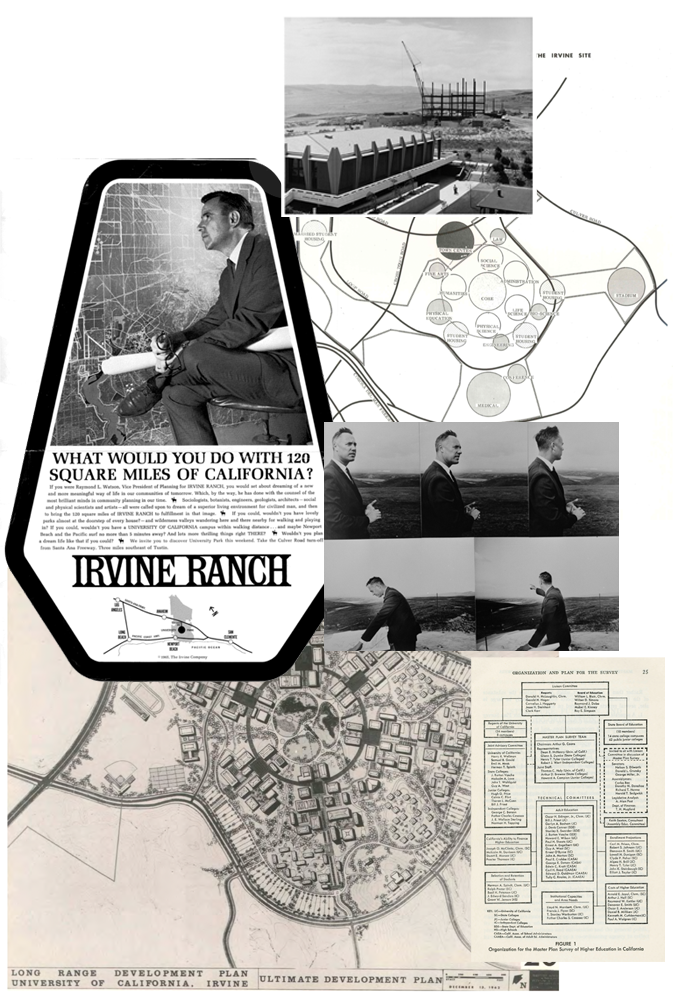
Between the late 1940s and early 1960s, state bureaucrats and university administrators embarked on a far-reaching effort to order and shape post-war Californian society by higher education, calling for radical expansion of the public higher education system. Architecture was the manifested intent and consequence of this political venture: Bureaucrats set out to “program” additional needed campuses with quantitative methods, and architects interpreted their statistical prompts into spatial forms. This dissertation poses an architectural history of the University of California at Irvine (UCI) as a history of this grand-scale planning effort, situated between the scales of administrative systematization endeavors, the institutional formats designed therein, and the campus as the spatial environment built as a result thereof.
Treated as a once-in-a-century opportunity for the design of a compact environment for the educational upbringing of a new generation of citizens, the University of California campus at Irvine was an administrative and architectural experiment for “educational pioneers” in the deserted landscape of Southern California. The campus, opened in 1964, distilled the entire endeavor’s approach: the round, UFO-like building interpreted new, cybernetics-infused ideas of interdisciplinarity, feedback, and rationalization into spatial form. Sitting alone on the once colonized land of the Irvine Ranch, its architects William Pereira and Charles Luckman envisioned the campus as the center of a “Great University,” a campus and town development that could eventually expand onto the whole ranch. The four chapters analyze the newfound state and college bureaucracy of masterplanning, the statistical calculations legitimizing additional institutions, the contested search for “new land” for campuses, and the architectural designs for UCI following the ideologic claim to a new educational frontier.
With the help of a narrative of a re-enchanted US-American frontier, these planners legitimized a radical spatial intervention in form of a new higher education institution and a surrounding town development, enacting the visions of a society, literally, shaped by education. As such, this history of campus planning accounts for the wide-reaching aspirations for administrative control of subjects in and through a planned environment. It foregrounds the conflicted self-narrative of an apparently progressive endeavor in order to disentangle it from the dominant narrative about its time: the long, “experimental” and “utopian” 1960s in California.