The Matter of Metadata: Archival Constructions between Index Cards and AI
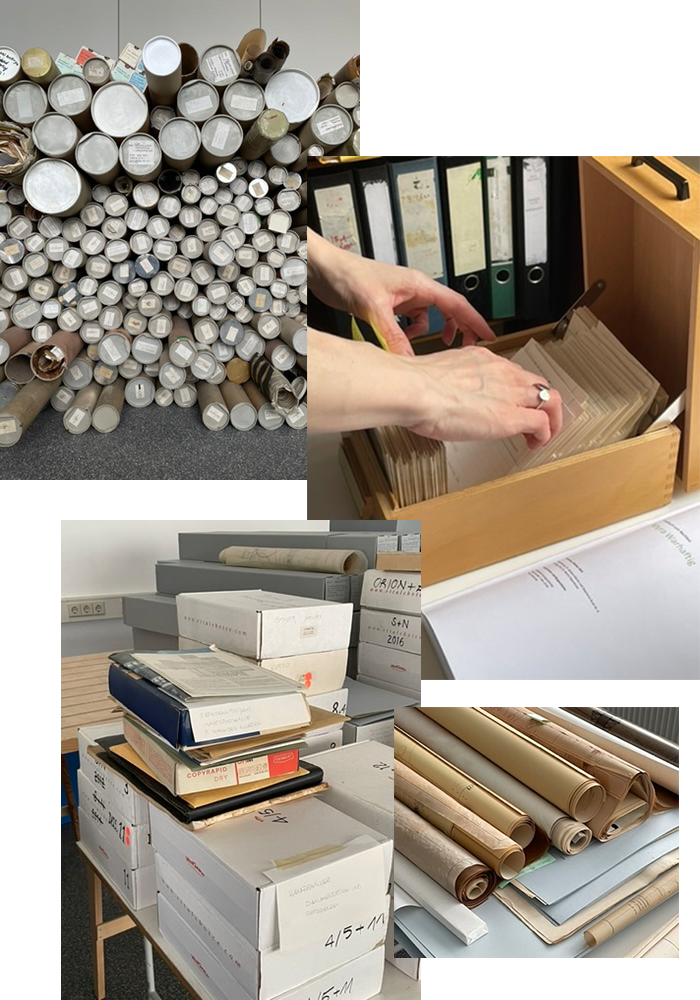
At the saai Archive at KIT, I work together with Anna-Maria Meister and Mechthild Ebert in the research project The Matter of Metadata. We ask what happens when metadata is seen not just as information, but as a subject shaped by processes, infrastructures, and materialities in the archive. Interested in the blind spots layers of databases, archival techniques, and metadata have produced in architectural archives, we intend to scrutinize the worlds behind the final layer of interface today’s users get to work with. With AI in the archive at the horizon, we see it crucial to investigate these historical layers prior to further transpositions into biased databases. As part of my research start-up position at KIT between 2024–2026, I develop what we call the medial-institutional subproject of this collaborative research project: Gestaltung durch Verwaltung: Metadatenstrukturen, Sammlungsnarrative und Institutionswerdung in deutschsprachigen Architekturarchiven.
Project Description
The sub-project focuses on the medial-material framework conditions of collection policies and metadata structures in architectural archives at German-speaking technical universities between 1965 and 1997 in Karlsruhe, Munich and Zurich. It combines an institutional-historical-comparative approach with a micro-historical approach: Starting from an administrative diagnosis, the institutional histories of these archives are to be rethought from their “marginal” materials and techniques in order to make an inter-institutional discourse of actors, specialist media and policies visible. The direction of the analysis thus first moves into the administrative depths and details of those archives in order to understand and analyze metadata structures as entities endowed with narrative agency from within the institution and informed by discourse. This reveals a research desideratum that is comparable to the investigations that museum collections (fine arts, ethnographic collections, “world culture museums”) have initiated in the recent past: To illuminate and critically scrutinize the structural conditions of their own collecting activities in order to design more diverse and equal repositories of the future based on those analyses. The sub-project argues that metadata structures still form a network of linked proto-historiographies of architectural histories written and to be written, which refer to these very archives. Proto-historiographies, because conscious and unconscious collection policies, especially in the form of the metadata structures - any categories, standards, working materials and tools - are written down and yet remain invisible as “non-content” of the archives. In this sub-project, the paper technologies, archival systematics, ordering principles, early software/computer technologies and archival spaces intertwined in this are re-centered, examined in their media and spatial specifics and reflected and questioned in the inter-institutional discourse. The desideratum of the sub-project is to distil these metadata structures in their material-ideal forms and to examine them theoretically and in terms of disciplinary history for the first time.